Pages

Showing posts with label museum. Show all posts

Sunday, February 26, 2017

A Church, A Museum, A Historical Landmark

Intramuros, Manila has many popular sites that have attracted its visitors and among them is the San Agustin Church. The building itself is a historical landmark and it has its own museum attached to it.

The Church of San Agustin is the oldest stone church in the Philippines. It was constructed from 1586 to 1606 under the consecutive supervision of Augustinian Fathers. The building was so stable that the periodic earthquakes produced minimal damage.  Terms for the surrender of Manila to the Americans by the Spaniards were discussed in the church in 1898. Damaged in the Battle of Manila in 1945 when the Americans liberated the Philippines from the Japanese. It was repaired years after the war. The first Philippine plenary council was held here in 1953. One of the four Baroque Churches of the Philippines inscribed on the World Heritage List in 1993 by UNESCO.

Photo by Dennis Portez

It is located along Gen. Luna Street besides the CBCP building and just across the Casa Manila. The museum is on the right side where a monastery previously stands. Its visitors during hours where there is no mass are mostly tourist, even non-Catholic tourists. The museum charges 100 pesos for entrance fee.

Photo by Dennis Portez

The entrance room is not that stylish but still stimulates interest. The very first thing a visitor sees is the large bell at the center of the room. It is quite dark so some of the paintings are hard to see.

Photo by Dennis Portez

Photo by Dennis Portez

Photo by Dennis Portez

Photo by Dennis Portez

The museum is a two – story square gallery that you will walk clock-wise and is enclosing a garden with a fountain on the center. Visitors can take pictures with no flash along the walkway. There are a few rooms however where picture taking is not allowed. On the easternmost part of the museum is a burial chamber where the ashes of early Spanish conquerors and former priests now rest.

Photo by Dennis Portez

At the left of the first walkway is an entrance leading to the church. Figures of four saints are placed on this door.

Photo by Dennis Portez

Photo by Dennis Portez

The church walls and ceiling are elegantly designed. Images are artistically made and are on display on each corner of the church. The church choir has 68 carved molave seats with narra inlaid and an artistic book-stand.

Photo by Dennis Portez

The grand stairway of the museum only has a faint light.

Photo by Dennis Portez

Photo by Dennis Portez

The second floor has more lighting making it easy for me to take clear photos. Majority of the exhibits here are paintings but there is a separate room for artifacts. The religious library is also located here although its conservation and organization is still on-going.

The entire visit to the church and its museum will take about half to one hour, though it might take longer if you wish to know more about the details. Overall the visit to the church of San Agustin is a great experience, especially if you are a devoted catholic.

Wednesday, February 4, 2015

The UPLB Museum of Natural History

Do you want to see a tamaraw skeleton or a king cobra prepared to attack? Do you want to see an assembly of remarkable rocks and sea shells? These and other things that have formed Mother Nature can be found here at the UPLB Museum of Natural History!


The Museum of Natural History was established on September 30, 1976 by the University of the Philippines. It has a varied collection that showcases the Philippines’ rich biodiversity. It consists of preserved biological and zoological specimens, by-products of microorganism and serves as a reference for documentation, research, and information.

The Museum of Natural History is a continuation of our (me and my family) tour on Mount Makiling forest reserve. It is just a few meters away from the Makiling Botanic Garden and can be seen on the left side of the road when going up the mountain.

Curiosity to see the collections has brought us here. The museum at that time was really crowded. A school was presently conducting their educational field trip when we got there. Although jam-packed, we are not disappointed at the timing of our visit. The rooms filled with students have made it livelier.


The Museum is a two-storey building. At the ground floor is the cave biodiversity that exhibits bats and the marine biodiversity exhibit which features a large jaw of a sperm whale, different kinds of shells and marine life bones. Preserve animals and skeletons can also be found here.

Wandering around the museum is really entertaining as we are also being educated. The preserve animals were group together according to their environment, such as grassland, rain forest and beach forest. We are glad that we bring along our six year old daughter here.


The second floor is where we found the collection of mushrooms, rocks, insects and by-products of microorganism. I did not enjoy looking at the insects though I loved the collection of amazing rocks.


For the preservation of some of the exhibits, the only part of the Museum with air-conditioning is the marine life exhibit. So I advice those who want to visit the Museum to bring refreshments with you.


The Museum is open Mondays to Saturdays from 8:00 AM to 5:00 PM. The Museum accepts walk-in visitors. For advanced booking / reservations for large groups such as class field trips, please contact their Booking Coordinator:

Ms. Lita Borromeo
Administrative Officer
+63 (049) 536-3669

Or email mnh@uplb.edu.ph or mnhuplb@gmail.com
Rates
Adult: P 20.00 (High school and college students, professionals and other adults)
Children: P 10.00 (Pre-schoolers and grades-schoolers)

The Museum of Natural History also accepts donations for the maintenance and development of more interesting exhibits in the future.

How to get to there:
By Public Transport:
1. Board a bus ( BLTB Bus, Green Star Bus, JAM or JAC Liner) at the terminal in Cubao or Taft Avenue bound for Sta. Cruz Laguna.
2. Get off at Los Baños Junction.
3. Ride a jeepney to UPLB College of Forestry and tell the driver to drop you at the UPLB Museum of Natural History.
Tip: Raise your index finger (aka pointer finger) as a sign for jeepney drivers that you will go up along the College of Forestry.

By Private Transport:
1. From Manila drive to South Luzon Express Way (SLEX) and take the Calamba Exit.
2. Take the National Highway to Lopez Avenue in Los Baños.
3. Turn right onto Lopez Avenue.
4. Continue onto Jose R. Velasco Avenue.
5. Turn Left onto Narra.
6. Continue onto bridge.
7. Continue onto Domingo lantican Avenue.
8. Turn left onto Makiling
9. You will see the sign "Museum of Natural History" at your left side.

Monday, September 2, 2013

Philippine Aerospace Museum


I think all kids love planes. That's why the PAF Aerospace Museum is one of the popular educational tour destinations in Metro Manila. This Museum is a legacy, built to honor our heroes in the Philippine Air Force. 


The PAF Aerospace Museum, Villamor Air Base is beside Ninoy Aquino International Airport Terminal 3. The Museum was opened in June 2007. Villamor Air Base is the PAF's first headquarters since it became independent of the Philippine Army on July 1, 1947.
This Museum is an ideal place to visit for researchers, students and families. Remnants used during WWII are displayed throughout the building. Miniature Airplanes, weaponry, medals, old uniform and the Presidents command car are among the exhibit.

P-51D "MUSTANG": A World War II vintage.


Model Planes of the Philippine Air Force from 1947 to present.


The Philippine Army Air Corps Saber during the Philippine commonwealth. (1935 - 1945)


Philippine Air Force Heraldic Flags and Lineage from 1947 to 2007.


Dodge WC - 57 Command Car: Remodelled by Sarao Motors in 1970's to change its Army truck look to an elegant Command Car for use of the President of the Philippines. It has served all the way through the incumbency of former President Marcos.


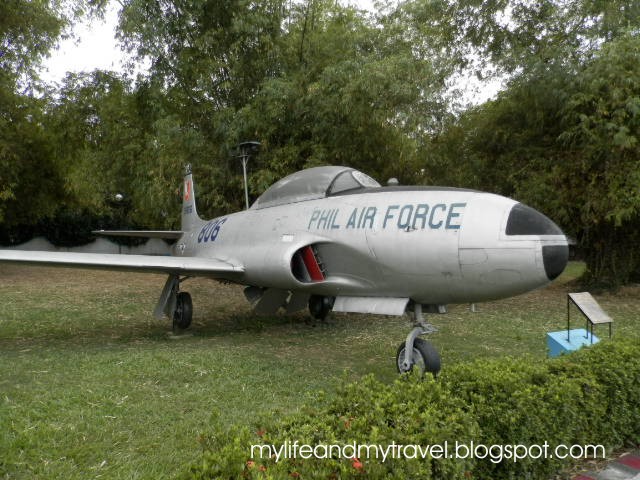
After wandering the museum, visitors can explore an outdoor aircraft park showcasing commercial planes, Air Force planes and helicopters. For students and family, it can be a pleasure to be in actual planes and helicopters used by the Philippine Airmen during WWII. Visitors can take exterior and interior photos.

YS - 11A: Atransport aircraft mainly for use by the President and the first family from 1971 to 1993.


T-41: Acquired by the Philippines in 1968 for pilot training. 


T-S "TEXAN": Aquired in 1948 and served as basic trainer.

T - 28 "TROJAN": Purchased in 1960 and used in basic training and counter insurgency. It was commonly called "Tora-Tora" since it is similar to the Japanese Zero Fighter in WWII.


C – 47 “Gooney Bird”: The World most famous commercial transport plane. Acquired in 1946 and was used by the Philippine Army Air Corps for air transport functions. In 1973 it was converted to a fighting aircraft. It was also used for rainmaking and rain suppression operations.

ALBATROSS “HU – 16”: Called general utility amphibian plane. It has the ability to take off and land in both land and water.

UH – IH “IROQUOIS”:  Also known as “HUEY”, used primarily for air mobility and rapid deployment of troops.

F – 5A “FREEDOM FIGHTER: Delivered to the Philippines on August 29, 1965 and was assigned to the 5th Fighter Wing, Basa Air Base, Pampanga. Today, it serves as the front line fighter of the PAF.

F – 86D: Acquired by the PAF in 1960 and was used for air defense functions. It was phased out in 1968.


F – 8H: Delivered to the Philippines in 1978. Used for air defense, surveillance and reconnaissance missions. 

T – 33 “T – Bird”: The first Jet trainer. Acquired in 1955 and was used for jet qualification, instrument training and proficiency flying. It was the World’s most widely used jet trainer.

S – 62B / HH – 52A “SIKORSKY”: Used to provide air transport for the President of the Philippines from 1968 to 1975. It was eventually phased out due to its engine feature that did not conform to the requirements for VIP transport.

H – 34 “CHOCTAW” (S-58): Used in search and rescue operations from 1969 to 1980. It was also used for troop transport, aerial photogrammetry, mapping and intelligence work. It was phased out in October 1974.


A souvenir shop is also in the Museum with various PAF aircraft and PAF logo items such as T- shirts for sale. Visitors can purchase refreshments and snacks here as well. The entrance fee is 20 PHP/person and complimentary for Air Force family members. 

For more information:
Contact#: (63) 2-8323498

Hours of Operation: 8:00am - 12:00pm (Monday to Friday), 8:00am - 12:00pm (Saturday) 

Total Pageviews